Serum Violet Is Style Serum's Colour of 2027
We've named a deep, blue-leaning violet our Colour of the Year, with Lilac Glow as its companion. Here's why we chose it, and how brands can use it.
By Sukhvinder Jabbal ·
Our pick for 2027
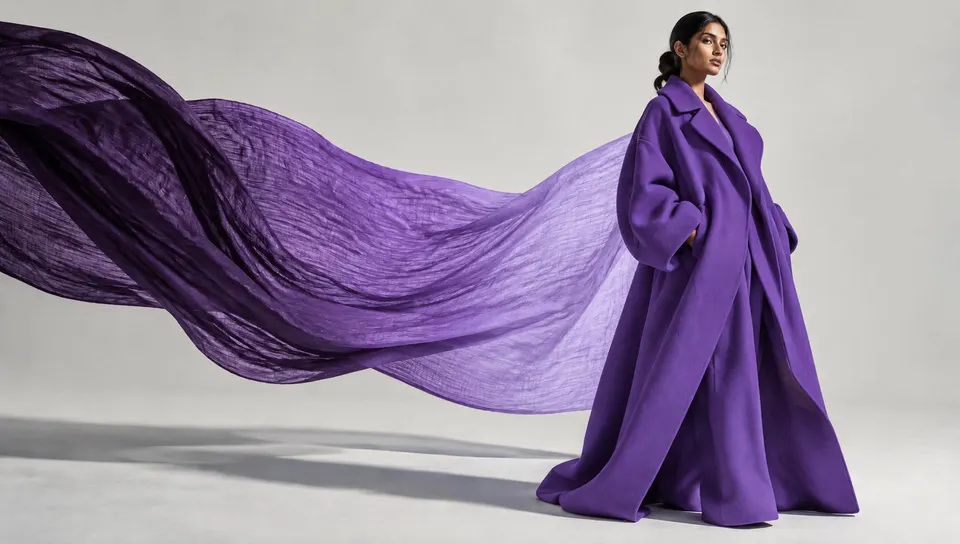
Style Serum's editors have named Serum Violet (HEX #6B3FA0) our Colour of the Year for 2027. It is a deep, saturated violet that leans slightly towards blue, and it comes with a lighter companion shade, Lilac Glow (HEX #C3A6F0). Colour codes, palettes and free downloadable images are on our Colour of the Year page.
This is the first time we have named a colour of the year. It is an editorial choice, not a forecast built on proprietary sales data, and it is not affiliated with Pantone, WGSN or Coloro. Violet has also been the colour of our own masthead since we launched, which is why the shade carries our name. What we can offer is a clear argument, open sources and practical guidance, so you can judge it for yourself.
Reason one: purple has changed who gets to wear colour
For most of history, a lasting purple was hard to make. Writing in Smithsonian magazine, Cooper Hewitt's Jennifer Cohlman Bracchi explains that Tyrian purple is believed to have originated in Phoenicia as early as 1200 BC and was made from the mucus of Mediterranean sea snails, an expensive and labour-intensive process. Its colourfastness, as well as its price, made it a mark of status.
That changed in 1856. According to the Royal Society of Chemistry, 18-year-old chemist William Perkin produced mauve, the first synthetic organic dye, while trying to synthesise the anti-malaria drug quinine. London's Science Museum says the synthetic dye boom started with mauveine, which Perkin made from coal tar. The museum also notes the environmental damage that synthetic dyes went on to cause, a cost the industry is still dealing with.
Perkin's discovery turns 170 this year. Purple has twice changed fashion: first as a colour only the powerful could afford, then as the colour that made bright dyes cheap enough for everyone. Serum Violet is a deeper, modern take on that history.
Reason two: saturated violet is back on the runway
Purple is not a fringe idea. In October 2025, FashionUnited reported that the trend-analysis company Heuritech had declared purple the trend colour of the Spring/Summer 2026 season, "from lilac to aubergine", with examples from Valentino, Celine, Moschino and Giorgio Armani.
Vogue saw the same thing. In January 2026 it named violet among the jewel-bright colours of Pierpaolo Piccioli's first Balenciaga collection. In March 2026 it reported that saturated royal purple had reappeared on many spring runways, from Versace tailoring and Prada and Valentino dresses to Hermès accessories and Chloé florals, as well as in plum and violet street style.
These are 2026 signals, not proof of what will sell in 2027. But they show that designers, buyers and shoppers are already comfortable with strong purple. Serum Violet takes that deeper, darker shade into the year ahead, rather than the pale lavender of recent seasons.
Reason three: the next chapter of colour-making is often purple
Purple also sits at the edge of new dye technology. The Austrian start-up Vienna Textile Lab works with bacteria, and explains that most members of the chromobacteria group produce a purple dye as they mature. The European Space Agency has published images of violacein, a purple pigment, produced by Massilia bacteria in its research.
The wider field is growing. The University of Cambridge's commercialisation arm describes how Colorifix uses engineered microorganisms to produce, deposit and fix pigments onto textiles. An August 2026 scientific review in Biotechnology for the Environment says dyeing with live microorganisms can work under mild conditions and has the potential to reduce energy, water and hazardous chemical use.
These technologies are still small, and none of them yet makes Serum Violet at industrial scale. A purple dye is not automatically sustainable. But just as purple marked the start of synthetic dyeing, it is now one of the colours scientists are using to explore biological dyeing. Brands working on Serum Violet can ask their mills a useful question: how was this colour made?
Why not blue
WGSN and Coloro named Luminous Blue their Colour of the Year 2027 in April 2025, alongside Energy Orange, Pop Pink, Meadowland Green and Clay. We covered that forecast in Luminous Blue: What 2027's Colour Forecast Means for Fashion and Beauty. Paint brands, including Dulux, Sherwin-Williams and Behr, have chosen greens.
We did not want to repeat a colour that had already been named. None of the 2027 picks we checked is a violet. We don't claim to have discovered purple: Pantone chose Ultra Violet in 2018 and the periwinkle Very Peri in 2022, and interiors writers have already spotted aubergine for 2027. Serum Violet is our own specific shade and argument.
Pantone has announced a Colour of the Year 2027 event for 3 December 2026 but had not named its colour as of 8 November 2026. We will report on it when it does.
How to use Serum Violet
Ready-to-wear: wear it head to toe in tailoring and outerwear, or as one strong piece against off-white. Wool and brushed fabrics soften it; satin makes it louder.
Occasionwear: pair it with marigold yellow, its natural opposite on the colour wheel, for festive and bridal capsules.
Beauty: eyeliner, nail lacquer, hair colour and packaging. Lilac Glow works as a softer shade in the same range.
Accessories: patent bags, sneakers with a lime sole and silk scarves are easy ways for shoppers to try a bold colour.
Digital: white text on Serum Violet meets the WCAG AA contrast standard for body text; black text does not.
Production: screen colours are only a starting point. Request lab dips and print proofs before bulk orders.
The full palette (Serum Violet, Lilac Glow, Aubergine, Marigold, Chalk and Lime Spark) and four suggested pairings are on the Colour of the Year page. Dye and fabric suppliers will show new developments at the fairs in our events calendar, and more colour and runway coverage is in Trends.
For brands and media
Journalists and creators can download the press kit images free for editorial coverage, with credit to Style Serum. Brands planning a Serum Violet product or campaign can talk to us about a labelled collaboration. The colour choice itself is never for sale.
The campaign image with this story is an AI-generated illustration, not a photograph of a real collection.
Sources
Smithsonian magazine: Why was purple the color of royalty?, 5 July 2022
Royal Society of Chemistry: Carol Vorderman turns fashion clock back 150 years to honour colour genius, 27 September 2006
Science Museum: The colourful chemistry of artificial dyes, 9 April 2019
FashionUnited: Spotted on the catwalk: SS26 trends according to Heuritech, 13 October 2025
Vogue: The key 2026 color trends to note for spring, 21 January 2026; Royal purple is coming for your wardrobe, 6 March 2026
Vienna Textile Lab: The discovery of chromobacteria, 2021
European Space Agency: Violacein pigment produced by bacteria, 27 July 2023
Cambridge Enterprise: Colorifix case study, 28 October 2024
Biotechnology for the Environment: Biological and sustainable textile coloration with live microorganisms, 3 August 2026
WGSN and Coloro: Colour of the Year 2027 announcement, 29 April 2025
Dulux UK, Sherwin-Williams and Behr: 2027 colour announcements, August–September 2026
Pantone: events and webinars, accessed 8 November 2026

Written by
Sukhvinder JabbalContributing Editor, Styling & Trends
NIFT-certified high-fashion and corporate stylist in Bengaluru with about eight years in runway, editorial, menswear and wardrobe styling.