
Making fashion repair work as a business
Repair creates value when design, pricing and operations keep garments in use—not when it merely generates a promotional voucher.
By Style Serum Editorial Desk · · Edited by Vasundhara Chopra
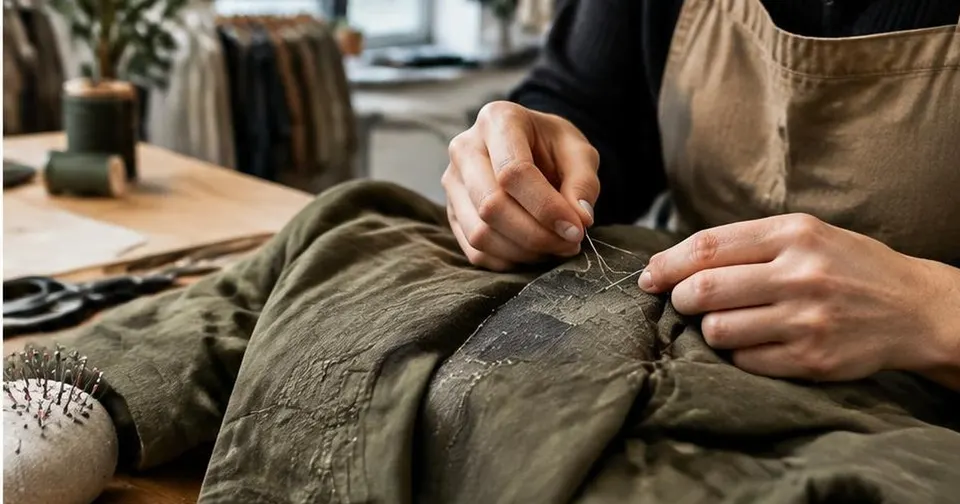
Start with the service, not the slogan
Repair can turn a damaged garment back into something useful. It can also create paid skilled work, deepen customer relationships and reveal recurring design failures. None of those outcomes is automatic. A service with unpredictable prices, long delays or poor workmanship may be technically available but practically inaccessible.
UNEP’s global textile roadmap places shifting consumption patterns alongside improved practices and investment in infrastructure. Repair fits that system-level approach when it helps people obtain more useful service from existing products. It is less convincing when presented as a small environmental add-on to an unchanged strategy of selling ever more short-lived garments.
The business question is therefore specific: whose clothing will be repaired, what failures can be addressed reliably, and who pays for the work? A viable answer needs an operating model before it needs a campaign name.
Choose a clear commercial model
A paid repair service charges customers for labour, components and associated handling. It can work for garments whose financial or personal value justifies the price. A brand-funded service instead treats repair as part of the product offer, with costs recovered through garment margins or a defined service allowance. Neither model makes labour free; each simply allocates the cost differently.
A subscription or institutional service can make demand more predictable. For example, an illustrative workwear supplier might include seam repairs and selected component replacements within a uniform contract. Because garments return through an existing laundry route, repair can share transport and inspection processes. That advantage would need testing rather than assuming that subscriptions always outperform individual transactions.
A partnership model sends work to independent tailors or specialist workshops. This can avoid duplicating local expertise, but the brand still needs clear quality requirements, payment terms and responsibility for customer complaints. Outsourcing workmanship should not mean outsourcing accountability.
Build the unit economics honestly
The useful unit is a completed, accepted repair—not simply an item received. Cost estimates should include intake, diagnosis, customer communication, skilled labour, replacement components, cleaning where needed, quality control, packaging, transport and unsuccessful cases. A superficially profitable sewing operation may lose money once the surrounding administration is counted.
Offer a small initial menu: button replacement, open-seam repair, hemming or a defined zipper service. Publish what is included and what requires inspection. Complex alterations and repairs to fragile fabric may need individual quotes because the underlying material can fail beyond the repaired area.
Consider an illustrative jacket with a broken zipper. If intake reveals sound fabric and a replaceable construction, a standard repair may be sensible. If the coating is deteriorating and the zipper is bonded into several layers, the same promise could create excessive work and an unreliable result. Diagnostic refusal can be responsible when explained honestly and paired with other realistic options.
Design products that workshops can service
Repairability begins before sale. Accessible seams, replaceable fastenings, compatible spare parts and understandable construction can reduce repair time. Durability testing should examine likely failure points as well as the strength of the main fabric. A garment with excellent abrasion performance may still become unusable because a proprietary buckle is unavailable.
The European Commission JRC’s textile procurement technical report provides a useful institutional reference for considering product lifetime and service arrangements. Published in 2017, it is guidance and technical evidence, not a newly enacted blanket repair obligation for fashion brands.
Workshops also need product information. A style reference, fabric specification, care limitations and component catalogue can prevent repeated investigation. Share patterns or repair instructions where appropriate, while ensuring independent repairers are not forced into unnecessarily complex digital systems. Straightforward access often matters more than a sophisticated customer interface.
Make convenience and fairness part of quality
Customers need a quote, expected turnaround, visible repair options and a clear remedy if the work is defective. Explain whether matching fabric is available or whether a visible patch will be used. Obtain consent before changing the appearance of a valued garment. Accessibility matters too: postal-only services may be unsuitable for customers without convenient collection points.
Repair workers need realistic time allowances and safe working conditions. A low advertised price achieved through uncompensated diagnosis or unrealistic piece rates transfers the burden to the people providing the service. Evaluate partners on workmanship and labour practices, not just turnaround and price.
Some items require specialist competence. Protective clothing, waterproof constructions and products with safety-critical features should not receive generic repairs that compromise intended performance. Define the boundary of the service before accepting such items.
Measure continued use rather than marketing reach
Track accepted repairs, repeat failures, turnaround, customer satisfaction and fully loaded contribution margin. Where feasible, ask whether the garment returned to regular use and for how long. Receiving an item, repairing it and preventing a replacement purchase are three different outcomes.
Environmental claims need comparable evidence about likely product life, displaced purchases, transport and repair inputs. A completed repair is not automatically a fixed quantity of avoided emissions. Discounts on new garments may also stimulate additional purchases, weakening the claimed benefit.
A credible pilot starts narrowly, gathers failure data and changes product design in response. If repeated pocket tears lead to a stronger, serviceable construction in the next production run, repair has become more than an after-sales gesture. It is functioning as a feedback loop between customers, skilled workers and the business model.
Continue the analysis
This discussion connects with Recycled fibres: useful tools with real limits and GOTS and GRS explained: read the standard, version and claim. Explore the full Sustainable Fashion section for related coverage.
Editorial note: This is source-based explanatory analysis, not firsthand reporting or a supplier audit. The cover is an AI-generated editorial illustration, not a photograph of a named company, designer or event.
Style Serum Editorial Desk
Source-based industry explainers
Explanatory analysis prepared from the official sources cited in each article. No original interviews or supplier audits are implied.

Reviewed by
Vasundhara ChopraContributing Editor, Fashion Business & India
NIFT-certified stylist with an MA in Luxury Brand Management from Regent's University London, covering fashion business, retail and Indian fashion.
More in Sustainable Fashion
Qorium rebrands as Reyva ahead of commercial leather rollout
Style Serum News Desk ·
EU fashion rules: what textile EPR and ESPR actually require
Style Serum Editorial Desk ·
Recycled fibres: useful tools with real limits
Style Serum Editorial Desk ·