
Scaling Indian Craft Without Erasing Its Makers
A commissioning and attribution workflow for designers moving from a craft sample to repeat production.
By Vasundhara Chopra ·
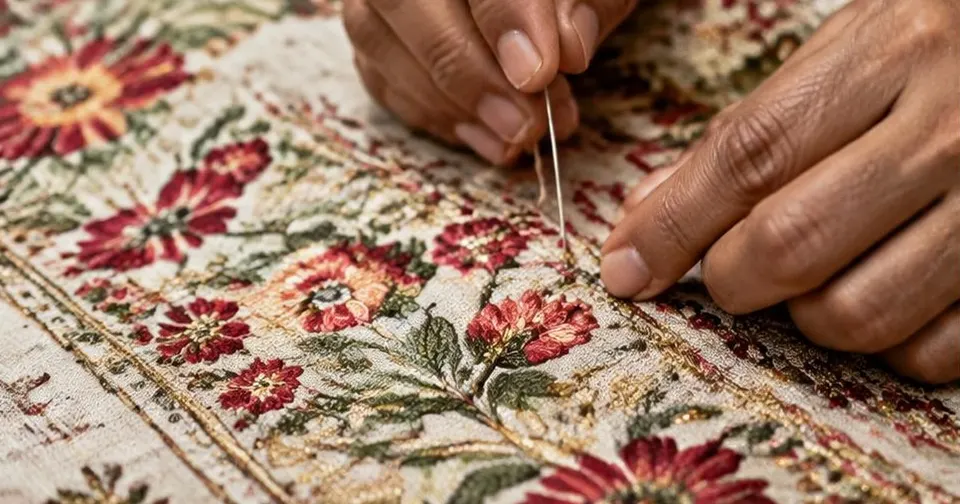
Scale the relationship, not just the motif
A designer can place a large order for a traditional technique and still leave its makers invisible. The problem often begins when a sample’s history is reduced to a mood board: a place name disappears, a contemporary artisan’s drawing becomes “folk inspiration,” and production intermediaries acquire the authority to approve every use. Scaling responsibly means identifying contributions and permissions before the collection becomes difficult to change.
This guide offers a practical commissioning workflow, not a claim that all Indian craft has the same ownership structure. Community-held traditions, an individual artist’s original work, a cooperative’s production knowledge and a protected geographical name can coexist. Each raises a different question about authority, credit and commercial terms.
Identify what you are actually using
Create a reference record for every proposed craft element. Include where the reference came from, the maker if known, the technique, any named community or region, and whether the design is historical or newly created. A museum image, social-media post or purchased textile is evidence of a reference, not necessarily permission to reproduce it commercially.
WIPO’s traditional cultural expressions and fashion guidance explains that textiles, attire, symbols and designs can be closely connected to Indigenous Peoples’ identity and that inappropriate use without consent can cause harm. That guidance is particularly relevant where Indigenous cultural expressions are involved; it should not be stretched into a claim that every Indian craft community has identical status or protocols.
Ask local collaborators which elements are ordinary commercial designs and which have restrictions, ceremonial significance or limits on adaptation. Do not assume that an older motif is unrestricted simply because a conventional copyright claim is unclear. Conversely, avoid declaring that one person owns an entire tradition when the authority to approve use is collective or contested.
Establish who can agree to what
Map the parties: individual designer, artisan, workshop, cooperative, intermediary and any relevant community representatives. Ask what each can authorise. An intermediary may be able to arrange production without having authority to license a community-held symbol or an artist’s original illustration. Record unresolved questions rather than filling them with a broad “inspired by India” credit.
WIPO’s discussion of cultural appropriation and intellectual property examines the role and limitations of IP tools. Treat its analysis as guidance, not a universal clearance certificate. Legal availability and respectful collaboration are related but different tests; meeting one does not automatically settle the other.
Obtain advice for the specific jurisdictions and rights involved where the commercial stakes warrant it. Copyright, designs, trademarks, contracts and geographical indications can raise separate issues. For geographical claims, IP India’s GI introduction explains the distinction between a registered proprietor and an authorised user. A production contract alone cannot make an inaccurate GI description legitimate.
Agree on design, payment and credit before production
Use a written brief understandable to all parties, with translation where needed. Identify the approved sample, permitted adaptations, product categories, territory, duration and whether exclusivity is being purchased. Clarify ownership and permitted reuse of newly commissioned drawings, photographs and technical files rather than assuming payment transfers every right.
Separate development fees from production prices. Agree who pays for sampling, revisions, materials, transport and rejected work, and when payments fall due. If royalties or another continuing benefit are part of the arrangement, define the calculation, reporting and payment schedule. There is no single fair percentage that can be prescribed for every craft partnership.
Write the credit at the same time. Specify how the maker or collective wants to be named and where attribution will appear: product page, label, packaging, press release and wholesale materials. Obtain permission for names, portraits and personal stories. Public visibility should not be compulsory when a collaborator prefers privacy or when disclosure could create risks.
Engineer repeat orders around real capacity
Before promising a launch date, ask about loom availability, competing orders, seasonal obligations, material lead times and training needs. Distinguish acceptable handmade variation from failures that affect fit, durability or safety. Keep approved reference samples and measurable specifications, but do not demand machine-like uniformity and then reject the characteristics the collection was designed to celebrate.
Make subcontracting visible. Establish whether additional workshops may be involved, how they will be approved, and how prices, instructions and attribution reach them. A single credited master artisan should not conceal the contribution of a wider team. Where individual names are impractical, agree on an accurate collective description rather than inventing a story of solitary authorship.
Make approval and repair part of the launch
Provide collaborators with proposed product descriptions and campaign imagery before publication. Reserve time for corrections, especially for cultural terminology, origin claims and any representation of ceremonial meaning. Marketing must distinguish a hand-worked component from a wholly handmade garment and a regional inspiration from production in that region.
After launch, check that credits survive retailer uploads, translations and repeat orders. Maintain a route for complaints, correction and renegotiation if the product expands into new categories. Scaling craft responsibly is an ongoing arrangement: clear authority, paid contributions, accurate attribution and a supply chain whose growth does not depend on making its makers disappear.
Continue the analysis
This discussion connects with India Apparel Export Compliance: From IEC to Shipment Files and Understanding India’s Silk Supply Chain Beyond the Sari Label. Explore the full India Fashion section for related coverage.
Editorial note: This is source-based explanatory analysis, not firsthand reporting or a supplier audit. The cover is an AI-generated editorial illustration, not a photograph of a named company, designer or event.

Written by
Vasundhara ChopraContributing Editor, Fashion Business & India
NIFT-certified stylist with an MA in Luxury Brand Management from Regent's University London, covering fashion business, retail and Indian fashion.
More in India Fashion
Surat textile businessman gives ₹1 lakh Diwali bonuses to 20 employees
Style Serum News Desk ·
India Fashion Trade Shows 2027: Textile and Sourcing Fair Dates
Style Serum Editorial Desk ·
Handloom Mark, India Handloom Brand and GI: Three Different Authenticity Questions
Style Serum Editorial Desk ·